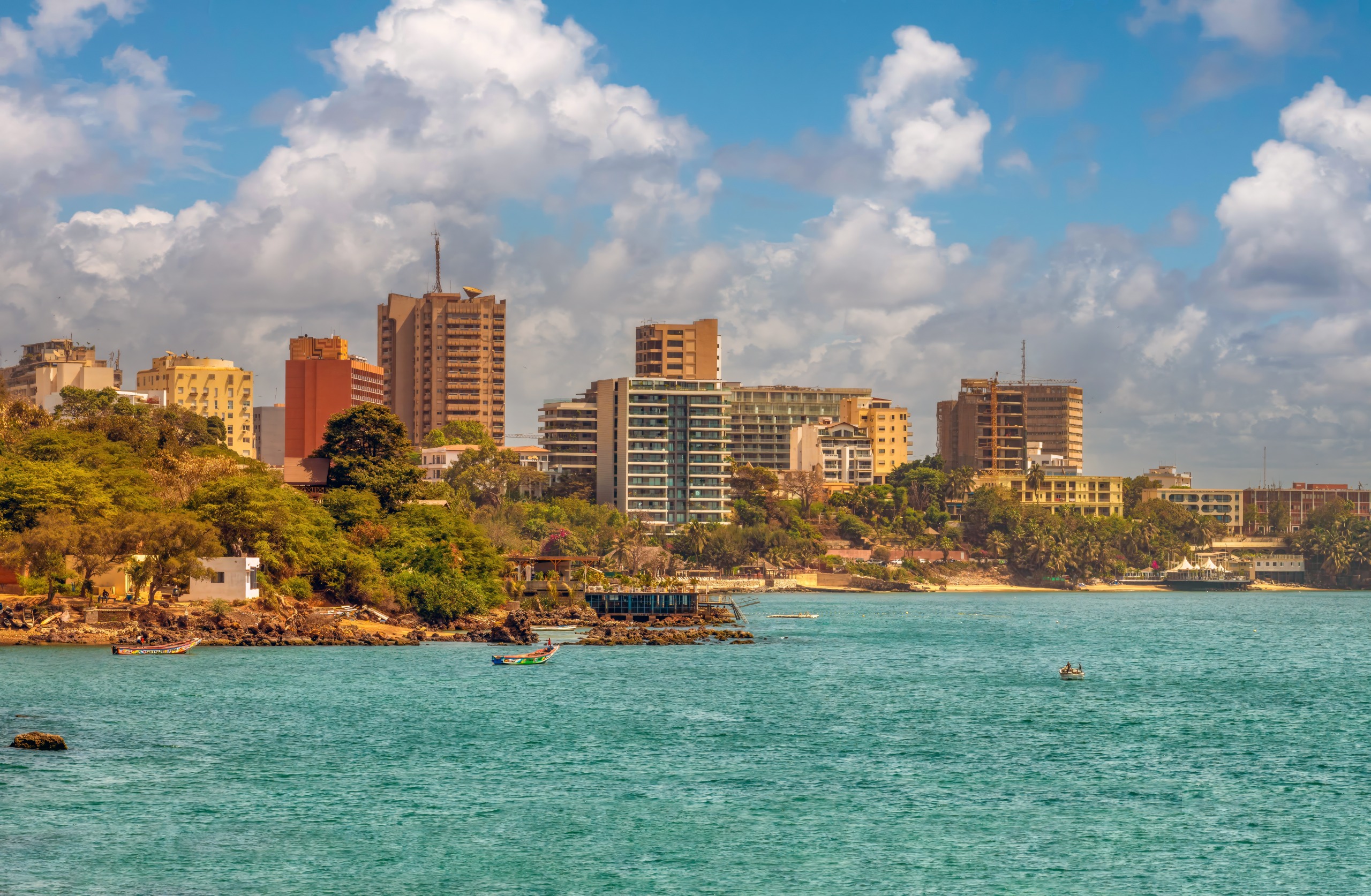
Saint-Louis and the North
A former colonial capital on an island between river and ocean, Saint-Louis opens onto the Djoudj delta and the Senegal River valley, bathed in soft light from November to March.
Saint-Louis du Sénégal, founded in 1659 by French merchants at the mouth of the river, occupies a two-kilometre-long island connected to the mainland by the Faidherbe Bridge, a 507-metre steel structure inaugurated in 1897. The city served as capital of French West Africa until 1902, then of Senegal and Mauritania until 1957. This administrative past left behind a dense urban fabric of courtyard houses, wooden balconies and ochre facades, designated a UNESCO World Heritage Site in 2000. The southern quarter of the island concentrates the former homes of signares, those mixed-race women who dominated trade in the 18th century.
The character of the region stems from its singular geography: three parallel bands separated by water. The mainland to the east, the historic island at the centre, then the Barbarie Spit, a thirty-kilometre sand bar separating the Senegal River from the Atlantic Ocean. The fishing quarter of Guet Ndar, perched on this strip of sand, concentrates nearly 25,000 inhabitants per square kilometre. Colourful pirogues return in late afternoon, and the sorting of fish on the beach sets the rhythm of local life. Demographic pressure and coastal erosion are threatening this band of sand; several houses have been swallowed by the sea in recent years.
North of Saint-Louis, the Djoudj national bird park covers 16,000 hectares of flooded plains in the river delta. The world's third-largest bird sanctuary, it welcomes three million migratory birds between November and April. By motorised pirogue, you can approach the colonies of white pelicans nesting on islets, pygmy flamingos, goliath herons, African cormorants and anhingas. A three-hour outing from the reception post is enough to traverse the main waterways. In contrast, the Barbarie Spit park protects the mouth zone, where the river's course was dramatically altered in 2003 by the opening of a breach intended to prevent flooding, which subsequently widened to several kilometres.
Beyond Saint-Louis, northern Senegal stretches towards the Senegal River valley. The Richard-Toll road, 100 km away, crosses rice paddies and the sugar-growing zone of the Senegal Sugar Company. Further on, Podor and Île à Morphil concentrate Toucouleur and Peul villages along the river, the natural border with Mauritania. To the east, the Ferlo, a vast semi-desert Sahelian zone, is home to Peul herding and the Katané reserve where oryx algazelles and dama gazelles have been reintroduced. The Louga region, to the south, serves as a transition to Wolof lands and the groundnut basin.
Saint-Louisien culture rests on a distinctive blend: Wolof heritage, Peul presence, signare memory and French influence. The International Jazz Festival of Saint-Louis, created in 1993, transforms the city each May for four to five days, with paying stages at Place Faidherbe and free concerts in the neighbourhoods. Local cuisine revolves around thieboudienne, the national dish of rice, fish and vegetables, which Saint-Louisiens claim to have invented. Yassa with chicken or fish, marinated in lemon and onions, is the other culinary hallmark. Horse-drawn carts remain a common mode of transport in the historic island, where narrow streets are poorly suited to cars.
The climate is milder than in Dakar thanks to the maritime trade winds. Temperatures remain between 17 and 28 °C from November to March, with manageable humidity. It is this gentleness, combined with the low-angle light of the delta and the city's slow pace, that defines the atmosphere of Saint-Louis: a riverside rather than a seaside city, to be explored on foot between the Faidherbe Bridge and the cathedral.
Things to discover
The historic island on foot or by horse-drawn cart. Three hours wandering between the 1828 cathedral, Place Faidherbe and the courtyard houses of the southern quarter, with a stop at the photography museum housed in a former signare residence.
Pirogue outing at Djoudj. At sunrise between December and February, slow navigation among the colonies of white pelicans and rafts of pygmy flamingos, 60 km north of Saint-Louis.
Guet Ndar at the hour of pirogue returns. Around 4pm, watch the unloading and sorting of fish on the beach of the Barbarie Spit, in the country's most densely populated fishing quarter.
Jazz festival in May. Four days of concerts featuring Senegalese musicians and international guests, official stages at Place Faidherbe and spontaneous performances in the courtyards and bars of the island.
Journey upriver to Podor and Île à Morphil. Three hours' drive along the river, Toucouleur villages with earth mosques, the restored Podor fort and a trip on the Bou el Mogdad, a former river mail boat.
When to go
The best period extends from November to early March. Temperatures range between 17 and 20 °C at night and 26 to 28 °C in the afternoon, the northerly trade wind makes days dry and bright. It is also the season when migratory birds are present at Djoudj, peaking from mid-December to late February. April and May see temperatures rising to 32 to 34 °C, still tolerable on the coast, and coincide with the jazz festival in early May.
From June to October, the rainy season brings heavy heat, 30 to 35 °C with high humidity, and concentrated rainfall in August and September, around 250 mm over two months. The Djoudj trails become difficult and the park closes partially. The harmattan, a dry wind laden with sand, can reduce visibility from late December to February, especially in the river valley towards Podor, without, however, hindering a visit to Saint-Louis.
Practical advice
Allow three full days for Saint-Louis and its surroundings: one day for the island and Guet Ndar, one day at Djoudj, half a day on the Barbarie Spit or in a mainland village. To include Podor and the river valley, plan two additional days, as distances are long on sometimes poorly maintained roads. Access is by road from Dakar, 270 km taking four to five hours via the Ila Touba motorway then the national road, or by domestic flight from AIBD airport to Saint-Louis airstrip when flights are scheduled.
The region combines well with the Lompoul desert, 1h30 to the south, for a night in a sand dune bivouac, then with Dakar and the Petite Côte to complete a northern circuit. An extension towards the Sine Saloum naturally extends the journey southwards. Hotel comfort in Saint-Louis ranges from characterful guesthouses on the island to lodges on the Barbarie Spit. The destination suits contemplative travellers, lovers of colonial architecture, ornithologists and families seeking a slow pace, less so those seeking lively beaches or intense nightlife.