Sine Saloum
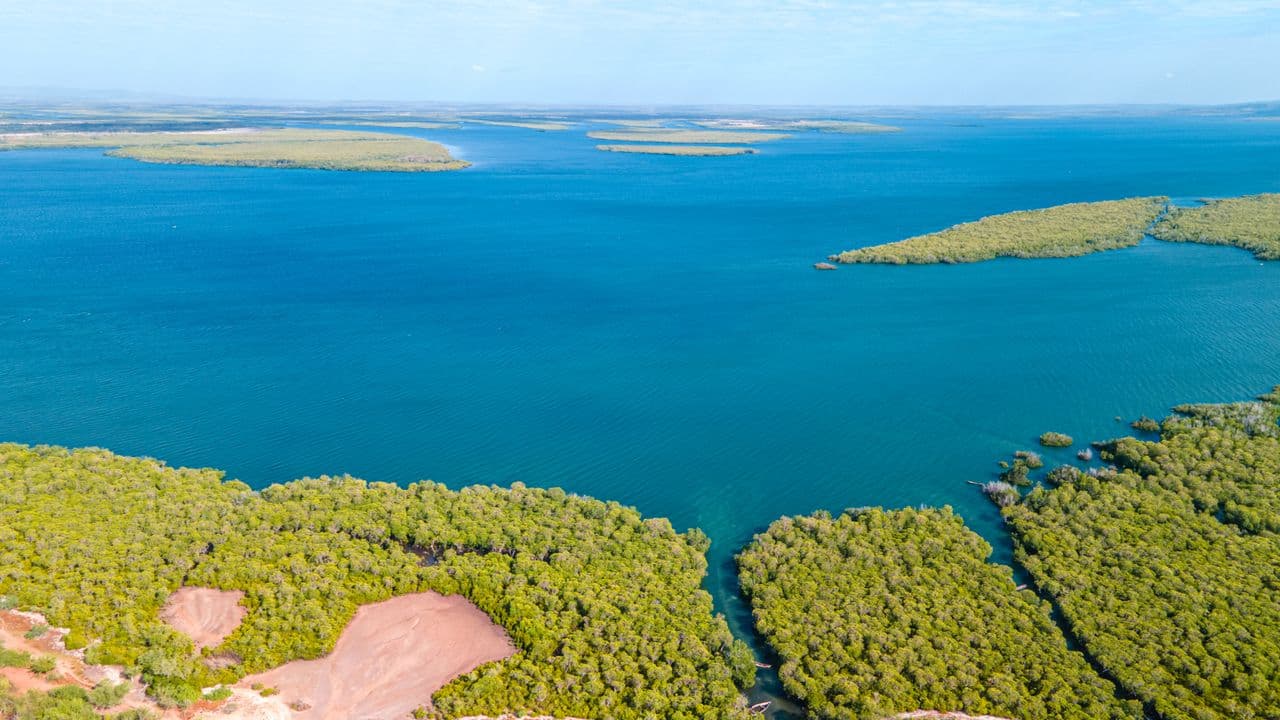
180,000 hectares of mangroves and bolongs inhabited by the Niominka Serer people, to explore by pirogue from Ndangane or Toubacouta between November and May.
The Saloum delta sprawls across 180,000 hectares south of the Petite Côte, where three rivers—the Saloum, Diomboss, and Bandiala—converge before emptying into the Atlantic. Designated a UNESCO biosphere reserve since 1981 and national park in its central section, this maze of bolongs (brackish waterways), salt flats, and mangrove islands is home to more than 200 villages, most of which are accessible only by pirogue. From our agency in Dakar, we regularly lead travelers there by road via Mbour and Fatick—count three hours to Ndangane or four hours to Toubacouta.
The delta's population is primarily Serer, and more specifically Niominka Serer on the islands. Fishermen, oyster farmers, lowland rice growers—they have developed an amphibious culture where the pirogue replaces the car, where tides are read like a calendar, and where shell middens, these white hills formed from oyster shells and ark shells accumulated over more than a thousand years, serve simultaneously as cemeteries, village foundations, and archaeological sites. The island of Joal-Fadiouth, connected to the mainland by a wooden boardwalk, offers the most accessible example, with its mixed Christian-Muslim cemetery built atop the shells.
The landscape shifts hour by hour with the tide. At low tide, the aerial roots of red mangroves (Rhizophora) reveal their oyster-encrusted root systems, harvested by women with machetes. At high tide, the bolongs become navigable deep into the villages. This dynamic nurtures remarkable birdlife—here you observe white pelicans, lesser flamingos, royal terns, little egrets, and pied kingfishers. Bird Island, near Toubacouta, welcomes a spectacular nesting colony of several thousand birds during the dry season.
At table, delta cuisine revolves around fish and rice. Yet (fermented mollusks) and guedj (dried fish) flavor tiep bou dien; grilled fish yassa replaces the chicken version here, and mangrove oysters are enjoyed smoked or in sauce. The lodges where we house our travelers—often a dozen discreet huts perched along a bolong at Mar Lodj, Palmarin, or Toubacouta—serve this repertoire with fish caught that morning. Evenings frequently end around attaya tea, sometimes punctuated by a traditional wrestling demonstration in nearby villages.
The delta presents two distinct gateways. To the north, Ndangane and Mar Lodj island offer a more intimate Saloum, with peaceful Serer villages and short pirogue crossings. To the south, Toubacouta and Missirah, on the edge of the national park, provide access to the widest bolongs, Dioron Boumak's shell island, and the nearby Gambian border. Palmarin, on the coastal sandspit, adds an oceanic dimension with its spotted-hyena lagoons and nearly deserted beaches.
What we appreciate about this region is its deliberate slowness. You don't check off sites—you glide by pirogue, you wait for the tide, you share a meal with a family from Dionewar or Niodior. The delta suits those who know how to slow down, observe, listen to silence broken by the cry of a fishing eagle.
Highlights
Pirogue through the Toubacouta bolongs. A 3 to 5-hour outing through the mangrove channels of the national park, with a stop at Bird Island at sunset when colonies of pelicans and cormorants return to roost.
Mar Lodj island. A Serer island reachable in 15 minutes by pirogue from Ndangane, explored on foot or by cart among baobabs, rice paddies, and Catholic-Muslim-animist villages living side by side.
Dioron Boumak shell middens. Artificial hills formed by a thousand years of oyster accumulation, planted with century-old baobabs. The site also serves as a traditional burial ground for Niominka notables.
Palmarin's hyena lagoon. A 4x4 outing in late afternoon through Palmarin's community reserve to observe spotted hyenas, warthogs, and antelopes in a landscape of salt flats and ronier palms.
Joal-Fadiouth, the shell island. A village built entirely on shells, connected by a 400-meter wooden bridge. Its mixed Christian and Muslim cemetery, perched on a neighboring island, is without equal in Sénégal.
When to visit
The best time to visit Saloum runs from November to May, during the dry season. Daytime temperatures range between 26 and 32°C, nights are cool in December-January (dropping to 18-20°C near water), and the maritime trade winds temper afternoons. It's also the season for Palearctic migratory birds, with peak observation between December and March. Pirogue outings are optimal, with no rain and clear water.
From June to October, the rainy season (hivernage) brings 600 to 800 mm of precipitation concentrated in a few thunderstorm episodes, often late afternoon. Temperatures rise to 33-35°C with high humidity, and mosquitoes are more present. Some lodges close in August-September. On the other hand, the delta turns intense green, rice paddies fill with water, and storm light offers another reading of the landscape. We nonetheless advise against this season for first-time visitors.
Practical advice
We recommend 2 to 3 nights in the delta to grasp its rhythm: a full day by pirogue with lunch on an island, a half-day of village exploration on foot or by cart, and free time at the lodge. One night alone leaves frustration; beyond 4 nights, repetition becomes a risk unless you combine the delta's two gateways (Ndangane in the north and Toubacouta in the south, separated by 1h30 of driving via Fatick). The delta has no airport; access is by road from Dakar (3 to 4 hours) or from Diass AIBD airport (2h30 to 3 hours).
The region pairs well with the Petite Côte just to the north for a coastal dimension, with Casamance further south via Gambia or by domestic flight from Dakar to Cap Skirring, and with Saint-Louis for a complete north-south circuit over 12 to 15 days. Lodge comfort ranges from eco-camping to more developed 3-star establishments, without grand luxury but with genuine local character. Saloum suits contemplatives, birdwatchers, sport fishermen (jack, barracuda), and families with children from 6-7 years old, who will enjoy pirogue outings and village life. Hikers and those seeking dramatic terrain will find more appeal in Bassari country.