Lake Rose (Lake Retba)
Lake Rose (Lake Retba)
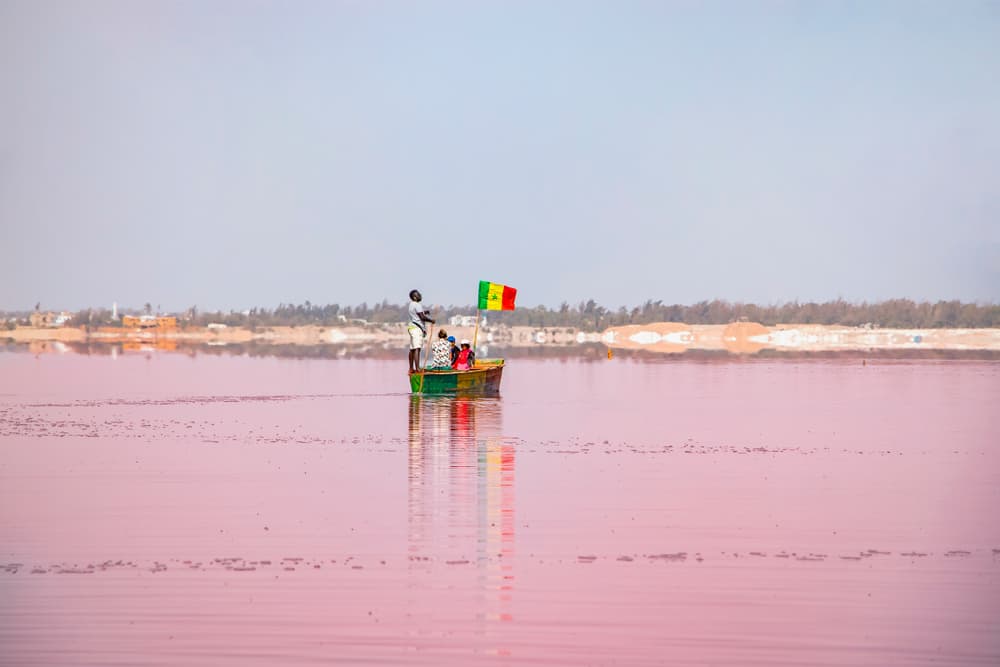
Some 40 km from Dakar, Lake Rose owes its striking hue to extreme salinity and a pigmented microalgae. Floating bathing, salt harvesters at work, and dunes facing the Atlantic.
Lake Rose, officially named Lake Retba, stretches some forty kilometres northeast of Dakar, separated from the Atlantic Ocean by a narrow band of dunes. Its pink colour — sometimes raspberry, sometimes lilac — results from an exceptional salt concentration and a pigmented microalgae. It is one of the rare hypersaline lakes accessible to the general public in West Africa, inscribed on the UNESCO World Heritage List as part of the Saloum Delta.
Quick facts
- Access: car or taxi from Dakar (Rufisque road then Niaga); local agencies offer organized transfers.
- Recommended duration: 2 to 3 hours to visit the lake, salt cooperatives and enjoy a swim.
- Attire: swimwear recommended if you wish to bathe; salt stains dark clothing.
- Important rule: rinse thoroughly after bathing — the salinity is extremely harsh on skin and eyes.
- Accessibility: sandy, unimproved shores make wheelchair access difficult.
What to see
The lake's surface ranges from pale pink to deep pink depending on time of day and season. Colourful pirogues glide between salt harvesters, men and women standing in the water, their bodies coated with shea butter for protection. Along the shores, mounds of white salt form an almost lunar landscape. Vendors offer seasoned salt, local crafts and floating experiences — the salt density exceeds that of the Dead Sea in places.
History and context
Lake Retba has been exploited for its salt for several centuries by the Lebou and Wolof communities of the region. Extraction remains artisanal: harvesters dive by hand or use long poles to scrape the lake bed. The lake also served as the finishing point for the Dakar Rally until 2007, before the event left Africa. Its pink colour is due to the combination of extreme salinity and the microalgae Dunaliella salina, which produces a red carotenoid pigment.
Highlights of the visit
Pink colour in raking light
The hue is most intense in late morning and early afternoon, when the sun is high. In the dry season (November to May), salt concentration is at its peak and colour most spectacular.
Salt harvesters at work
Observing — and sometimes briefly joining — workers harvesting salt by hand is the central human experience of the site. Some local guides arrange exchanges with cooperatives.
Floating bathing
The water's density allows effortless floating, as in the Dead Sea. Avoid any contact with eyes and cover cuts — the salinity burns.
Dunes and Atlantic coast
A short walk or quad ride from the lake leads to dunes separating it from the ocean. The contrast between pink water and Atlantic blue is striking from the ridge tops.
Photography tips
Late morning light (between 9 a.m. and noon) yields the most saturated pinks. Position yourself high on the dunes to frame lake and ocean together. Colourful pirogues and white salt mounds work well as foreground elements. Protect your camera: salt spray and fine sand are harsh on optics.
Location and access
Lake Rose sits in the Cape Verde peninsula, roughly 35–40 km northeast of central Dakar. The route passes through Rufisque and Niaga. Shared minibuses serve the area from Dakar, but a private vehicle is more convenient. Agencies based in Dakar offer day trips combining the lake, dunes and sometimes the fishing village of Yoff or the Great Mosque of Dakar.
Nearby
- Île de Gorée — less than an hour from Dakar, UNESCO-listed memorial site of the slave trade.
- African Renaissance Monument — monumental statue overlooking Dakar, visible from several neighbourhoods.
- Yoff Village — traditional Lebou village on the coast, with active Mouride community and lively beach.
- N'Gor Beach — popular Dakar beach, departure point for N'Gor island by pirogue.
Frequently asked questions
The dry season, from November to May, offers the highest salt concentration and thus the most intense colour. During the rainy season (July–September), rainfall slightly dilutes salinity and softens the pink hue.
Yes, swimming is possible and popular. Salt density allows easy floating. Avoid entering if you have open wounds, and rinse thoroughly afterwards — salt is highly irritating to skin and eyes.
Most local agencies offer day trips from Dakar including the lake, dunes and sometimes Yoff village or the northern coast. Round-trip travel from central Dakar takes roughly 1.5 hours depending on traffic.
There is no formal prohibition, but it is customary to ask harvesters' permission before photographing them. A small tip is often appreciated. Some local guides facilitate these exchanges.
Shores are sandy and unimproved, making wheelchair access difficult. No accessibility infrastructure currently exists on site.
Interested in this visit?
We can include it in your personalised itinerary.