Touba
Touba
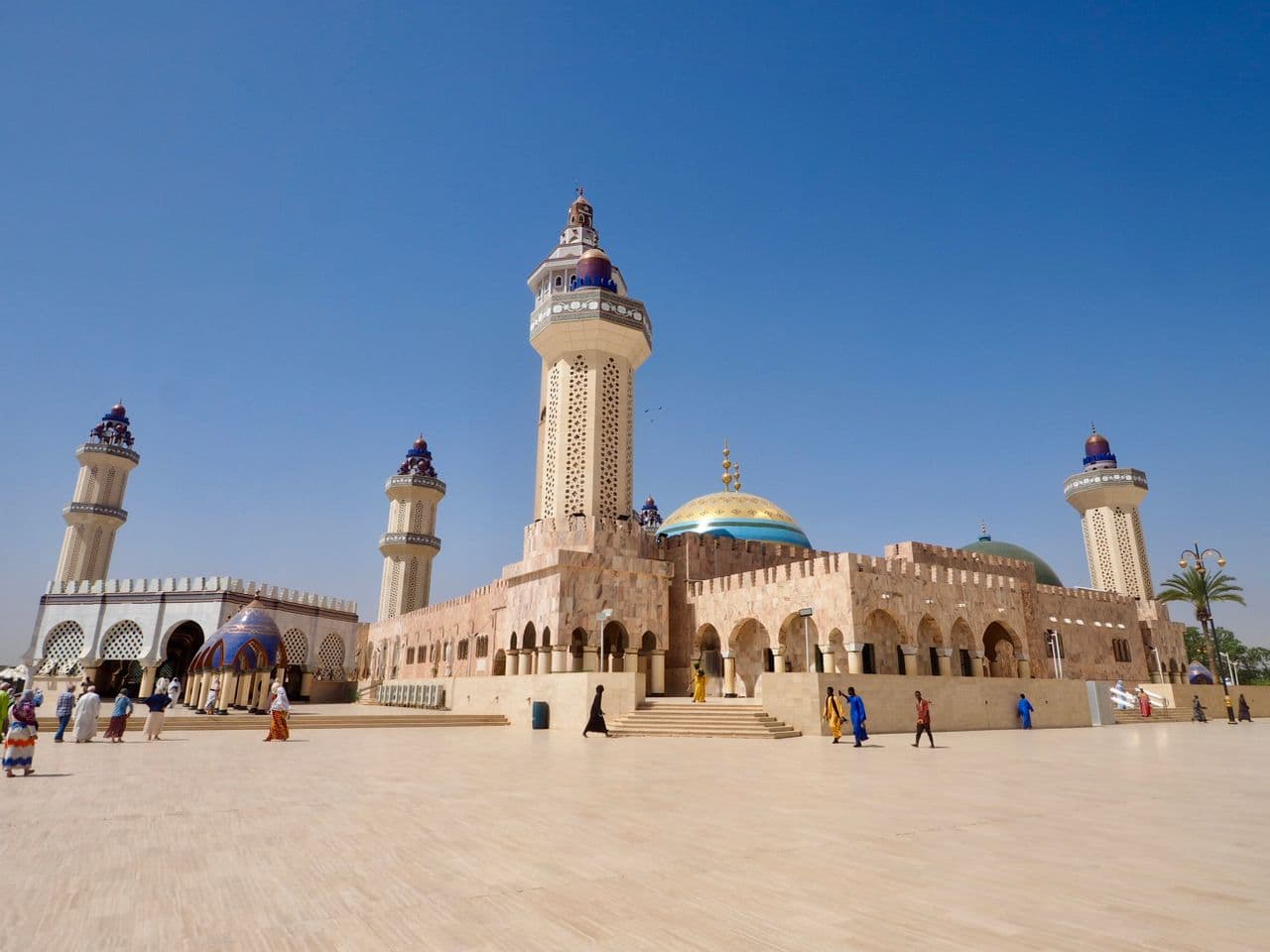
Touba is the sacred city of Mouridism, dominated by its Great Mosque with five minarets. Each year, millions of pilgrims gather there for the Grand Magal, a commemoration of Cheikh Ahmadou Bamba's exile.
Touba is the sacred city of Mouridism, a Sufi brotherhood founded by Cheikh Ahmadou Bamba in the late nineteenth century. Located in central Sénégal, approximately 190 kilometers east of Dakar, it welcomes millions of pilgrims each year during the Grand Magal. Its immense mosque, one of the largest in West Africa, dominates a city entirely dedicated to faith and the memory of its founder.
Quick reference
- Access: national highway from Dakar (approximately 3 hours by express bus or shared taxi); no active railway station.
- Dress code: modest dress required for all visitors, men and women; shoulders and knees must be covered.
- Alcohol and tobacco: strictly forbidden throughout the city—absolute rule, no exceptions.
- Recommended duration: one day is sufficient for the mosque and city center; two days if visiting during Magal.
- Period to avoid: roads are congested in the days preceding the Grand Magal; plan an early departure or arrange accommodation on site.
What to see
The heart of Touba is its Great Mosque, whose central minaret rises above 87 meters. The building, begun in 1931 and enlarged several times, can accommodate tens of thousands of faithful simultaneously. Around it, the city is organized into neighborhoods named after the sons of Cheikh Ahmadou Bamba. Markets, Islamic bookstores, and workshops weaving khassaïdes (religious poems) punctuate daily life.
History and context
Cheikh Ahmadou Bamba founded the Mouride brotherhood in the late nineteenth century, advocating work, prayer, and devotion to the marabout. Exiled twice by the French colonial administration—to Gabon and then to Mauritania—he returned to Sénégal cloaked in immense prestige. Touba, whose name means "happiness" or "beatitude" in Arabic, is the place he chose for his spiritual retreat and burial. The city enjoys a special status: it is administered by the general khalife of the Mourides, independently of ordinary municipal authorities.
Highlights of your visit
The Great Mosque of Touba
The architecture blends North African and Sahelian influences. Five minarets frame the central dome. The mausoleum of Cheikh Ahmadou Bamba is located inside; access to certain areas is reserved for Muslims. The outer courtyard is accessible to all visitors respecting the dress code.
The Grand Magal
Celebrated on the 18th day of the Islamic month of Safar, the Magal commemorates Cheikh Ahmadou Bamba's departure into exile in 1895. Between two and five million pilgrims converge on Touba over a few days. The atmosphere is unique: religious chanting, processions, and massive communal meals. For a non-Mouride visitor, the period is fascinating yet logistically demanding.
The library and manuscripts
Touba preserves an important collection of Arabic manuscripts and khassaïdes composed by Cheikh Ahmadou Bamba. Certain Islamic study centers accept visitors by prior request.
Etiquette and visiting rules
- Dress covering shoulders and knees is mandatory for everyone.
- Alcohol and tobacco are forbidden throughout the city—respect this rule without exception.
- Remove your shoes before entering the mosque.
- Always ask permission before photographing people, particularly women.
- Certain areas of the mausoleum are reserved for Muslim faithful; respect the signs on site.
- Speak quietly inside the mosque.
Photography tips
Morning light is ideal for photographing the façade of the Great Mosque, before crowds gather. The central minaret frames well from the main square. Avoid photographing the interior of the mausoleum without explicit permission. During Magal, scenes of crowds and devotion are striking, but remain discreet and respectful.
Location and access
Touba is located in the Diourbel region, approximately 190 kilometers east of Dakar via the RN3 national highway. Express buses and shared taxis depart regularly from Dakar's bus terminals (Pompiers or Colobane) to Touba. The journey takes between 3 and 4 hours depending on traffic. The city is also accessible from Thiès and Diourbel. Accessibility for people with reduced mobility in the mosque is limited due to stairs and crowds.
Nearby attractions
- Diourbel — regional capital about forty kilometers away, a transit point and bustling regional market.
- Thiès — city known for its tapestry manufactures and craft markets, approximately 100 kilometers to the west.
- Lac de Guiers — natural reservoir to the north, important for Sénégal's water supply, a setting for peaceful outings.
Want to discover this destination?
Our local advisors design your tailor-made trip.